
Persistence Simplices gives rise to Gene Families
Last updated on 2026-02-20 | Edit this page
Overview
Questions
- How can I apply TDA to describe Pangenomes?
- How can persistence simplices be related to gene families?
Objectives
- Describe Pangenomes using Gudhi
- Finding persistence families of genes
- Explore the change of gene families by varying the distance parameter
Persistent approach to pangenomics
We will work with the four mini-genomes of episode Measuring Sequence Similarity. First, we need to import all the libraries that we will use.
PYTHON
import pandas as pd
from matplotlib import cm
import numpy as np
import gudhi
import time
import os
Now, we need to read the mini-genomes.blast file that we
produced in the episode of Measuring
Sequence Similarity.
PYTHON
url = "https://raw.githubusercontent.com/carpentries-incubator/pangenomics/gh-pages/files/mini-genomes.blast"
blastE = pd.read_csv(url, sep='\t', names=['qseqid', 'sseqid', 'evalue'])
Obtain a list of the unique genes.
PYTHON
qseqid_unique=pd.unique(blastE['qseqid'])
sseqid_unique=pd.unique(blastE['sseqid'])
genes = pd.unique(np.append(qseqid_unique, sseqid_unique))
We have 43 unique genes, we can check it as follows.
OUTPUT
43Also, we will need a list of the unique genomes in our database.
First, we convert to a data frame object the list of genes, then we
split each gene in the genome and gen part, and finally we obtain a list
of the unique genomes and save it in the object
genomes.
PYTHON
df_genes=pd.DataFrame(genes, columns=['Genes'])
df_genome_genes=df_genes["Genes"].str.split("|", n = 1, expand = True)
df_genome_genes.columns= ["Genome", "Gen"]
genomes=pd.unique(df_genome_genes['Genome'])
genomes=list(genomes)
genomes
OUTPUT
['2603V', '515', 'A909', 'NEM316']To use the gudhi packages, we need a distance matrix. In
this case, we will use the evalue as the measure of how
similar the genes are. First, we will process the blastE
data frame to a list and then we will convert it into a matrix
object.
PYTHON
distance_list = blastE[ blastE['qseqid'].isin(genes) & blastE['sseqid'].isin(genes)]
distance_list.head()
OUTPUT
  qseqid	              sseqid	              evalue
0	2603V|GBPINHCM_01420	NEM316|AOGPFIKH_01528	4.110000e-67
1	2603V|GBPINHCM_01420	A909|MGIDGNCP_01408	4.110000e-67
2	2603V|GBPINHCM_01420	515|LHMFJANI_01310	4.110000e-67
3	2603V|GBPINHCM_01420	2603V|GBPINHCM_01420	4.110000e-67
4	2603V|GBPINHCM_01420	A909|MGIDGNCP_01082	1.600000e+00
As we saw in episode Measuring Sequence Similarity, the BLAST E-value represents the possibility of finding a match with a similar score in a database. By default, BLAST considers a maximum score for the E-value 10, but in this case, there are hits of low quality. If two sequences are not similar or if the E-value is bigger than 10, then BLAST does not save this score. In order to have something like a distance matrix we will fill the E-value of the sequence for which we do not have a score. To do this, we will use the convention that an E-value equal to 5 is too big and that the sequences are not similar at all.
PYTHON
MaxDistance = 5.0000000

# reshape long to wide
matrixE = pd.pivot_table(distance_list,index = "qseqid",values = "evalue",columns = 'sseqid')
matrixE.iloc[1:5,1:5]
OUTPUT
sseqid	2603V|GBPINHCM_00065	2603V|GBPINHCM_00097	2603V|GBPINHCM_00348	2603V|GBPINHCM_00401
qseqid
2603V|GBPINHCM_00065	1.240000e-174	NaN	NaN	NaN
2603V|GBPINHCM_00097	NaN	9.580000e-100	NaN	NaN
2603V|GBPINHCM_00348	NaN	NaN	0.0	NaN
2603V|GBPINHCM_00401 NaN NaN NaN 2.560000e-135OUTPUT
sseqid	2603V|GBPINHCM_00065	2603V|GBPINHCM_00097	2603V|GBPINHCM_00348	2603V|GBPINHCM_00401
qseqid
2603V|GBPINHCM_00065	1.240000e-174	5.000000e+00	5.0	5.000000e+00
2603V|GBPINHCM_00097	5.000000e+00	9.580000e-100	5.0	5.000000e+00
2603V|GBPINHCM_00348	5.000000e+00	5.000000e+00	0.0	5.000000e+00
2603V|GBPINHCM_00401	5.000000e+00	5.000000e+00	5.0	2.560000e-135
We need to have an object with the names of the columns of the matrix that we will use later.
OUTPUT
Index(['2603V|GBPINHCM_00065', '2603V|GBPINHCM_00097', '2603V|GBPINHCM_00348',
       '2603V|GBPINHCM_00401', '2603V|GBPINHCM_00554', '2603V|GBPINHCM_00748',
       '2603V|GBPINHCM_00815', '2603V|GBPINHCM_01042', '2603V|GBPINHCM_01226',
       '2603V|GBPINHCM_01231', '2603V|GBPINHCM_01420', '515|LHMFJANI_00064',
 ...,
       'NEM316|AOGPFIKH_01341', 'NEM316|AOGPFIKH_01415',
       'NEM316|AOGPFIKH_01528', 'NEM316|AOGPFIKH_01842'],
      dtype='object', name='sseqid')
Finally, we need the distance matrix as a numpy
array.
OUTPUT
array([[1.24e-174, 5.00e+000, 5.00e+000, ..., 5.00e+000, 5.00e+000,
        5.00e+000],
       [5.00e+000, 9.58e-100, 5.00e+000, ..., 5.00e+000, 5.00e+000,
        5.00e+000],
       [5.00e+000, 5.00e+000, 0.00e+000, ..., 5.00e+000, 5.00e+000,
        5.00e+000]
Now, we want to construct the Vietoris-Rips complex associated with
the genes with respect to the distance matrix that we obtained. In the
episode Introduction
Topological Data Analysis we saw that to construct the Vietoris-Rips
complex we need to define a distance parameter or threshold, so the
points within a distance less than or equal to the threshold get
connected in the complex. The threshold is defined by the argument
max_edge_length, and we will use here the value 2.
PYTHON
max_edge_length = 2
# Rips complex with the distance matrix
start_time = time.time()
ripsComplex = gudhi.RipsComplex(
    distance_matrix = DistanceMatrix,
    max_edge_length = max_edge_length
)
print("The Rips complex was created in %s" % (time.time() - start_time) )
OUTPUT
The Rips complex was created in 0.00029540061950683594Discussion: Changing the maximum dimension of the edges
To create the Rips Complex, we fixed that the maximum edge length was
2. What happens if we use a different parameter?
For example, if we use max_edge_lenght=1. Do you expect to
have more simplices? Why?
If we use a different max_edge_length we will obtain a
differente filtration with less or more simplices. In the case of
max_edge_lenght=1 we will have less simplices because we
stop the creation of simplices when the radius of the balls around the
simplices are 1.
As we see in the previous episodes, we now need a filtration. We will
use the gudhi function create_simplex_tree to obtain the
filtration associated with the Rips complex. We need to specify the
argument max_dimension, this argument is the maximum
dimension of the simplicial complex that we will obtain. If it is for
example 4, this means that we will obtain gene families with at most 4
genes. In this example, we will use 8 as the maximum
dimension so we can have families with at most 2 genes from each genome
or 8 different genes.
Note
For complete genomes, the maximum dimension of the simplicial complex needs to be carefully chosen because the computation in Python is demanding in terms of system resources. For example, with 4 complete genomes the maximum dimension that we can compute is 5.
PYTHON
start_time = time.time()
simplexTree = ripsComplex.create_simplex_tree(
    max_dimension = 8)
print("The filtration of the Rips complex was created in %s" % (time.time() - start_time))
OUTPUT
The filtration of the Rips complex was created in 0.001073598861694336With the persistence() function, we will obtain the
persistence of each simplicial complex.
PYTHON
start_time = time.time()
persistence = simplexTree.persistence()
print("The persistente diagram of the Rips complex was created in %s" % (time.time() - start_time))
OUTPUT
The persistente diagram of the Rips complex was created in 0.006387233734130859We can print the birth time of the simplices. If we check the output of the following, we can see the simplices with how many vertices they have and with the birth time of each.
PYTHON
result_str = 'Rips complex of dimension ' + repr(simplexTree.dimension())
print(result_str)
fmt = '%s -> %.2f'
for filtered_value in simplexTree.get_filtration():
    print(tuple(filtered_value))
OUTPUT
Rips complex of dimension 7
([0], 0.0)
([1], 0.0)
([2], 0.0)
([3], 0.0)
([4], 0.0)
([5], 0.0)
([6], 0.0)
([7], 0.0)
...OUTPUT
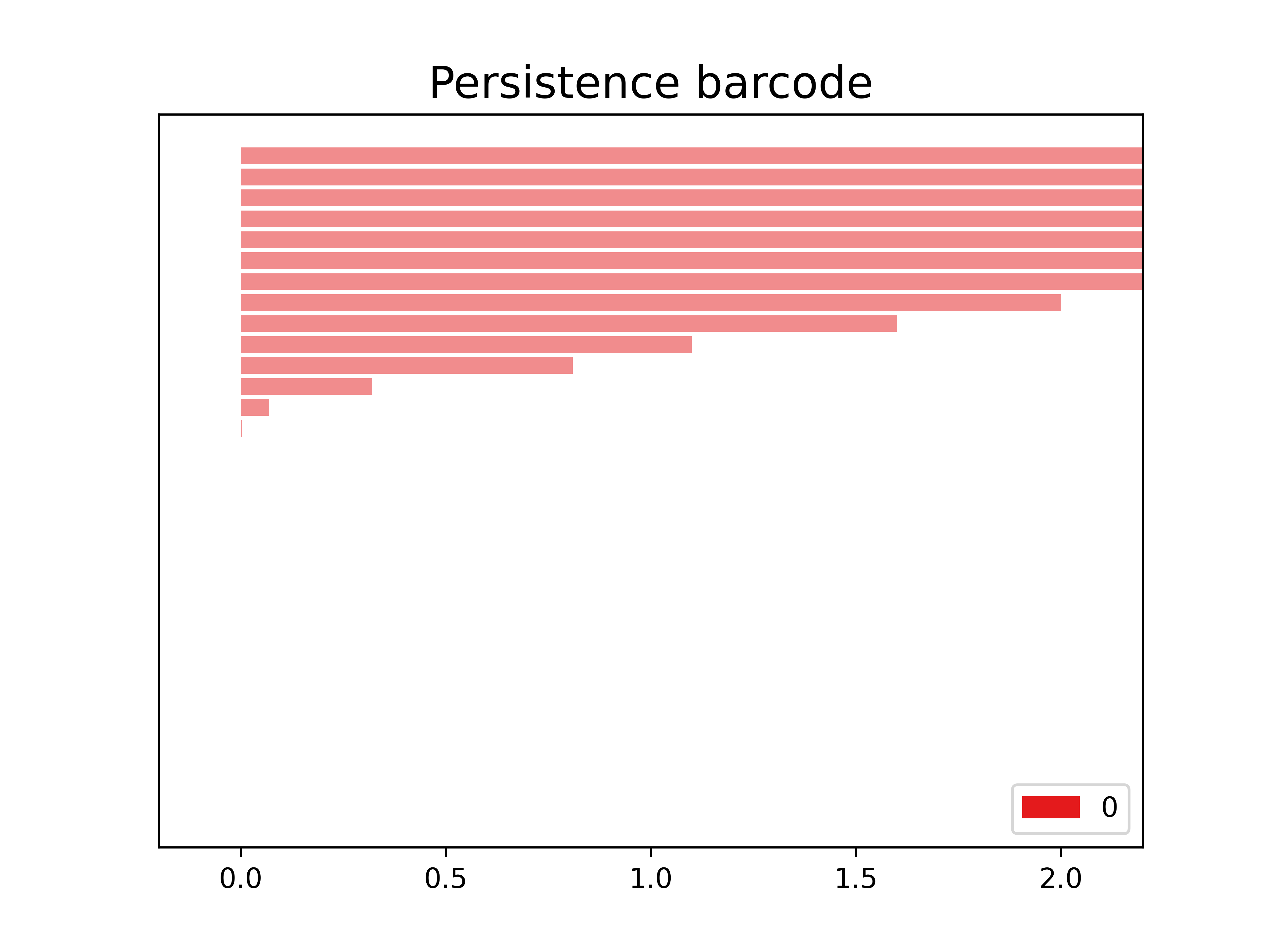
(7, 43, 467)The following is the barcode of the filtration that we created. We observe in this case that we only have objects in dimension 0.
PYTHON
start_time = time.time()
gudhi.plot_persistence_barcode(
    persistence = persistence,
    alpha = 0.5,
    colormap = cm.Set2.colors
)
print("Bar code diagram was created in %s" % (time.time() - start_time))
OUTPUT
Bar code diagram was created in 0.05829215049743652
The following function allows us to obtain the dimension of the simplices.
We filter according to the dimension function: it orders the simplices from largest dimension to smallest and then from longest birth time to smallest.
PYTHON
all_simplex_sorted_dim_1 = sorted(simplexTree.get_filtration(), key = dimension, reverse = True)
all_simplex_sorted_dim_1
OUTPUT
[([4, 9, 15, 18, 25, 30, 37, 39], 0.014),
 ([4, 9, 15, 18, 25, 30, 37], 0.014),
 ([4, 9, 15, 18, 25, 30, 39], 0.014),
 ([4, 9, 15, 18, 25, 37, 39], 0.014),
...
 ([35], 0.0),
 ([36], 0.0),
 ([37], 0.0),
 ([38], 0.0),
 ([39], 0.0),
 ([40], 0.0),
 ([41], 0.0),
 ([42], 0.0)]
Obtain the persistence of each simplex.
PYTHON
d_simplex_time = dict()
d_simplex_const = dict()
names = []
for tuple_simple in all_simplex_sorted_dim_1:
    list_aux = []
    if len(tuple_simple[0])-1 == simplexTree.dimension():
        t_birth = tuple_simple[1]
        t_death = max_edge_length
        d_simplex_time[tuple(tuple_simple[0])] = (t_birth,t_death)
        list_aux = tuple([name_columns[tuple_simple[0][i]] for i in range(len(tuple_simple[0]))])
        d_simplex_const[list_aux] = (t_birth,t_death)
    else:
        t_birth = tuple_simple[1]
        t_death = max_edge_length
        for simplex in d_simplex_time.keys():
            if set(tuple_simple[0]).issubset(set(simplex)):
                t_death = d_simplex_time[simplex][0]
        d_simplex_time[tuple(tuple_simple[0])] = (t_birth,t_death)
        list_aux = tuple([name_columns[tuple_simple[0][i]] for i in range(len(tuple_simple[0]))])
        d_simplex_const[list_aux] = (t_birth,t_death)
We can save the name of the simplices, i.e. the keys in the object
d_simplex_const, in a list called
simplices.
Now, we want an object with the information on how many genes of each genome are in each family.
PYTHON
bool_gen = dict()
genes_contains = dict()
num_new_columns = len(genomes)
for simplex in simplices:
    genes_contains = dict()
    genes_contains = {'2603V': 0, '515': 0, 'A909': 0, 'NEM316': 0}
    for i in range(len(simplex)):
        for genoma in genomes:
            if genoma in simplex[i]:
                genes_contains[genoma] = genes_contains[genoma] +1
    for gen in genomes:
        if gen not in genes_contains.keys():
            genes_contains[gen] = 0
    bool_gen[simplex] = genes_contains
bool_gen
The bool_gen numbers looks like:
OUTPUT
{('2603V|GBPINHCM_00554',
  '2603V|GBPINHCM_01231',
  '515|LHMFJANI_00548',
  '515|LHMFJANI_01178',
  'A909|MGIDGNCP_00580',
  'A909|MGIDGNCP_01268',
  'NEM316|AOGPFIKH_00621',
  'NEM316|AOGPFIKH_01341'): {'2603V': 2, '515': 2, 'A909': 2, 'NEM316': 2},
 ('2603V|GBPINHCM_00554',
  '2603V|GBPINHCM_01231',
  '515|LHMFJANI_00548',
  '515|LHMFJANI_01178',
  'A909|MGIDGNCP_00580',
  'A909|MGIDGNCP_01268',
  'NEM316|AOGPFIKH_00621'): {'2603V': 2, '515': 2, 'A909': 2, 'NEM316': 1},
...
('NEM316|AOGPFIKH_00855',): {'2603V': 0, '515': 0, 'A909': 0, 'NEM316': 1},
 ('NEM316|AOGPFIKH_01341',): {'2603V': 0, '515': 0, 'A909': 0, 'NEM316': 1},
 ('NEM316|AOGPFIKH_01415',): {'2603V': 0, '515': 0, 'A909': 0, 'NEM316': 1},
 ('NEM316|AOGPFIKH_01528',): {'2603V': 0, '515': 0, 'A909': 0, 'NEM316': 1},
 ('NEM316|AOGPFIKH_01842',): {'2603V': 0, '515': 0, 'A909': 0, 'NEM316': 1}}
How can we read the object bool_gen?
We have a dictionary of dictionaries. Every key in the dictionary is a family and in the values, we have how many genes are from each genome in each family.
Now, we want to obtain a dataframe with information on the time of
births, death, and persistence of every simplex (i.e. every family).
First, we will obtain this information from our object
d_simplex_time and we will save it in tree lists.
PYTHON
births = []
deaths = []
persistent_times = []
for values in d_simplex_time.values():
    births.append(values[0])
    deaths.append(values[1])
    persistent_times.append(values[1]-values[0])
Now that we have the information we will save it in the dataframe
simplex_list
PYTHON
data = {
    't_birth': births,
    't_death': deaths,
    'persistence': persistent_times
}
simplex_list = pd.DataFrame(index = simplices, data = data)
simplex_list.head(4)
OUTPUT
	t_birth	t_death	persistence
(2603V|GBPINHCM_00554, 2603V|GBPINHCM_01231, 515|LHMFJANI_00548, 515|LHMFJANI_01178, A909|MGIDGNCP_00580, A909|MGIDGNCP_01268, NEM316|AOGPFIKH_00621, NEM316|AOGPFIKH_01341)	0.014	2.000	1.986
(2603V|GBPINHCM_00554, 2603V|GBPINHCM_01231, 515|LHMFJANI_00548, 515|LHMFJANI_01178, A909|MGIDGNCP_00580, A909|MGIDGNCP_01268, NEM316|AOGPFIKH_00621)	0.014	0.014	0.000
(2603V|GBPINHCM_00554, 2603V|GBPINHCM_01231, 515|LHMFJANI_00548, 515|LHMFJANI_01178, A909|MGIDGNCP_00580, A909|MGIDGNCP_01268, NEM316|AOGPFIKH_01341)	0.014	0.014	0.000
(2603V|GBPINHCM_00554, 2603V|GBPINHCM_01231, 515|LHMFJANI_00548, 515|LHMFJANI_01178, A909|MGIDGNCP_00580, NEM316|AOGPFIKH_00621, NEM316|AOGPFIKH_01341)	0.014	0.014	0.000
Finally, we want the data frame with complete information, so we will
concatenate the objects simplex_list and
bool_gen in a convenient way.
PYTHON
aux_simplex_list = simplex_list
for gen in genomes:
    data = dict()
    dataFrame_aux = []
    for simplex in simplices:
        data[simplex] = bool_gen[simplex][gen]
    dataFrame_aux = pd.DataFrame.from_dict(data, orient='index', columns = [str(gen)])
    aux_simplex_list=pd.concat([aux_simplex_list, dataFrame_aux], axis = 1)
aux_simplex_list.head(4)
OUTPUT
	t_birth	t_death	persistence	2603V	515	A909	NEM316
(2603V|GBPINHCM_00554, 2603V|GBPINHCM_01231, 515|LHMFJANI_00548, 515|LHMFJANI_01178, A909|MGIDGNCP_00580, A909|MGIDGNCP_01268, NEM316|AOGPFIKH_00621, NEM316|AOGPFIKH_01341)	0.014	2.000	1.986	2	2	2	2
(2603V|GBPINHCM_00554, 2603V|GBPINHCM_01231, 515|LHMFJANI_00548, 515|LHMFJANI_01178, A909|MGIDGNCP_00580, A909|MGIDGNCP_01268, NEM316|AOGPFIKH_00621)	0.014	0.014	0.000	2	2	2	1
(2603V|GBPINHCM_00554, 2603V|GBPINHCM_01231, 515|LHMFJANI_00548, 515|LHMFJANI_01178, A909|MGIDGNCP_00580, A909|MGIDGNCP_01268, NEM316|AOGPFIKH_01341)	0.014	0.014	0.000	2	2	2	1
(2603V|GBPINHCM_00554, 2603V|GBPINHCM_01231, 515|LHMFJANI_00548, 515|LHMFJANI_01178, A909|MGIDGNCP_00580, NEM316|AOGPFIKH_00621, NEM316|AOGPFIKH_01341)	0.014	0.014	0.000	2	2	1	2
In this data frame, we can see the history of the formation of
families (simplices) at the different birth and death times. If we
filter at t_death=2we can see only the families that we
remain with in the end.
Exercise 1(Beginner): Partitioning the pangenome
Filter the table by t_death=2, at this point in the
filtration, which families are in each partition Core,
Shell and Cloud? How many of these are
single-copy core families?
We can filter as follows:
OUTPUT
	t_birth	t_death	persistence	2603V	515	A909	NEM316
(2603V|GBPINHCM_00554, 2603V|GBPINHCM_01231, 515|LHMFJANI_00548, 515|LHMFJANI_01178, A909|MGIDGNCP_00580, A909|MGIDGNCP_01268, NEM316|AOGPFIKH_00621, NEM316|AOGPFIKH_01341)	1.400000e-02	2.0	1.986	2	2	2	2
(2603V|GBPINHCM_00401, 515|LHMFJANI_00394, 515|LHMFJANI_01625, A909|MGIDGNCP_00405, NEM316|AOGPFIKH_00403, NEM316|AOGPFIKH_01842)	1.300000e+00	2.0	0.700	1	2	1	2
(2603V|GBPINHCM_01042, 2603V|GBPINHCM_01420, 515|LHMFJANI_01310, A909|MGIDGNCP_01408, NEM316|AOGPFIKH_01528)	1.600000e+00	2.0	0.400	2	1	1	1
(2603V|GBPINHCM_00065, 515|LHMFJANI_00064, A909|MGIDGNCP_00064, A909|MGIDGNCP_00627, NEM316|AOGPFIKH_00065)	8.600000e-02	2.0	1.914	1	1	2	1
(2603V|GBPINHCM_00348, 515|LHMFJANI_00342, A909|MGIDGNCP_00352, NEM316|AOGPFIKH_00350, NEM316|AOGPFIKH_01341)	3.000000e-03	2.0	1.997	1	1	1	2
(2603V|GBPINHCM_01042, A909|MGIDGNCP_01082, A909|MGIDGNCP_01408, NEM316|AOGPFIKH_01528)	1.600000e+00	2.0	0.400	1	0	2	1
(2603V|GBPINHCM_00748, 515|LHMFJANI_00064, A909|MGIDGNCP_00064, NEM316|AOGPFIKH_00065)	8.300000e-01	2.0	1.170	1	1	1	1
(2603V|GBPINHCM_00097, 515|LHMFJANI_00097, A909|MGIDGNCP_00096, NEM316|AOGPFIKH_00098)	9.580000e-100	2.0	2.000	1	1	1	1
(2603V|GBPINHCM_00815, 515|LHMFJANI_00781, A909|MGIDGNCP_00877, NEM316|AOGPFIKH_00855)	0.000000e+00	2.0	2.000	1	1	1	1
(2603V|GBPINHCM_00748, 2603V|GBPINHCM_01042, A909|MGIDGNCP_01082)	2.000000e+00	2.0	0.000	2	0	1	0
(2603V|GBPINHCM_00748, 2603V|GBPINHCM_01042)	2.000000e+00	2.0	0.000	2	0	0	0
(2603V|GBPINHCM_00748, A909|MGIDGNCP_01082)	2.000000e+00	2.0	0.000	1	0	1	0
(515|LHMFJANI_01625, A909|MGIDGNCP_01221)	1.100000e+00	2.0	0.900	0	1	1	0
(515|LHMFJANI_01130, A909|MGIDGNCP_01221)	1.310000e-85	2.0	2.000	0	1	1	0
(A909|MGIDGNCP_01343, NEM316|AOGPFIKH_01415)	7.890000e-143	2.0	2.000	0	0	1	1
(2603V|GBPINHCM_01226,) 0.000000e+00 2.0 2.000 1 0 0 0| Partition | Num. of Families |
|---|---|
| Core | 8 |
| Shell | 6 |
| Cloud | 2 |
Single-copy core families: 3
Excercise 2(Beginner): Looking for functional families
In the episode Measuring
Sequence Similarity we saw that the genes 2603V|GBPINHCM_01420,
515|LHMFJANI_01310, A909|MGIDGNCP_01408, and NEM316|AOGPFIKH_01528 make
the functional family 30S ribosomal protein. Look for these genes in the
aux_simplex_list. Are they in the same family? Are there
other genes in this family?
Yes, they are in the same family, but there is one more gene in this family, the gene 2603V|GBPINHCM_01042.
Exercise 3(Intermediate): Changing the dimension of the simplices
When we create the object simplexTree we define that the
maximum dimension of the simplices was 8. Change this parameter to
3.
With the new parameter, how many simplices do you obtain? And edges? If
you run all the code with this new parameter and filter again by
t_death = 2, what happens with the partitions? How many
families do you have?
PYTHON
start_time = time.time()
simplexTree = ripsComplex.create_simplex_tree(
   max_dimension = 3)
persistence = simplexTree.persistence()
simplexTree.dimension(), simplexTree.num_vertices(), simplexTree.num_simplices()
OUTPUT
(3, 43, 364)Now we have less simplices, we have 364 simplices.
When we filter by t_death = 2, we obtain 111 families
because some families share genes.
- Pangenomes can be described using TDA
- Persistence simplices are related to the gene families of a Pangenome
- Persistence simplices can be used to find some funtional families